CONTACT US
|
Wechat
WeChat:+8605925523433Wechat QR code,Contact us
WeChat:+8605925523433Wechat QR code,Contact us


Indonesian coffee is not a single flavor. Sumatra, Java, Sulawesi, Bali, Flores, and other regions can support distinct products. Indonesia’s official tourism website highlights coffees including Gayo, Toraja, Kintamani, Java Preanger, and Flores Bajawa.
When these coffees become drip bags, the machine does not handle a region name. It handles recently roasted and ground coffee that may continue releasing gas.
Research on roasted-coffee degassing explains that carbon dioxide release is relevant to packaging and that roasting conditions, grinding, and time influence the behavior.
Without a validated grinding-to-packaging process, individual envelopes may swell or become inconsistent in appearance. In more serious cases, the change can reveal insufficient seal or material design.
Machine selection should therefore consider more than output. The brand must define when coffee is ground, when it is packed, how much internal space the envelope requires, and whether the finished package remains intact during storage.
Roasting forms and retains gases inside coffee, which are released over time. Grinding changes the bean structure and its degassing behavior.
The result may vary with:
Arabica, Robusta, or blend composition.
Roast profile.
Resting time after roasting.
Grinding time and particle size.
Dose per bag.
Coffee temperature.
Envelope headspace.
Barrier and seal performance.
Storage temperature and duration.
A fixed resting time copied from another coffee is not reliable. Each Indonesian coffee should be evaluated using its actual roast and packaging system.
Envelope expansion may result from coffee releasing gas inside a sealed pack. It may also reflect air retained during packaging, nitrogen settings, or a sealing problem.
Investigate:
Whether the envelope already contained considerable air when sealed.
When swelling began.
Whether the entire lot changed consistently.
Whether the package remains sealed.
Whether unusual odor or moisture is present.
Whether gas release exceeds the space available.
Whether bag dimensions or machine settings changed.
Visual swelling alone does not prove spoilage or machine failure.
Before the machine trial, document the complete process from roasting to outer sealing.
Record:
End of roasting.
Completion of cooling.
Beginning and end of grinding.
Time the grounds enter the hopper.
Residence time in the hopper.
Inner and outer packaging time.
Case-packing time.
Storage conditions.
Samples can then be packed at different intervals and compared for shape, seal integrity, aroma, and brewing performance.
The process needs to balance two goals: avoiding excessive gas accumulation after very early sealing while limiting unnecessary aroma loss from prolonged exposure of ground coffee.
Depending on the model and configuration, the equipment may integrate coffee dosing, filter formation, ultrasonic inner sealing, hanging-support handling, individual outer wrapping, and coding.
Different Indonesian coffees may vary in bulk density and flow. Weight should be rechecked after changing origin, roast, or grind.
High-frequency mechanical vibration joins compatible filter material. It forms the inner bag; it does not stop degassing or independently determine shelf life.
The process is not entirely free of localized heat, and not every filter paper or nonwoven material is suitable.
The supports should unfold and remain stable on the cup. Excessive occupied volume may reduce pouring space or bring grounds closer to the seam.
The envelope provides barrier protection. Dimensions, heat-seal quality, and internal space should be evaluated together with the coffee’s degassing behavior.
The finished-product code should connect to roast, grind, and packaging times so that swelling or flavor concerns can be investigated.
A very tight envelope may leave little space around the inner filter. An excessively large envelope may reduce presentation quality, cartoning efficiency, and material efficiency.
Consider:
Actual filter dimensions.
Folded support thickness.
Coffee volume.
Seal width.
Cutting tolerance.
Observed gas release.
Gas-flushing requirements.
Downstream carton dimensions.
Increasing envelope size does not eliminate gas release or correct a poor seal. Several candidate formats should be evaluated through storage and transport testing.
Variation in pack thickness can interfere with downstream operations.
Possible effects include:
Inconsistent conveyor spacing.
Difficult stacking.
Counting errors.
Fewer packs fitting inside the carton.
Local carton bulging.
Additional compression during transport.
When automatic cartoning is planned, test with finished packs that have undergone the relevant storage interval, not only freshly produced flat samples.
Roasting conditions can influence carbon dioxide release. A small-scale trial can establish the product process:
Use one roast batch.
Grind or package at different intervals.
Keep dose and envelope format constant.
Observe pack shape over time.
Inspect seals.
Record aroma and brewing results.
Compare integrity after transportation.
The approved interval should be documented in the product specification and revalidated after changes to coffee, roast, grind, or packaging.
Nitrogen flushing can reduce oxygen present at packaging, but it does not stop coffee from releasing its own gas. Added gas also changes the initial envelope shape and internal volume.
When nitrogen is required, confirm the machine configuration and define:
Gas introduction point.
Residual-oxygen target and method.
Initial pack fullness.
Seal integrity.
Subsequent shape changes.
Effect on cartoning.
Nitrogen flushing, coffee degassing, and package swelling are connected but distinct issues.
Batch comparison and seal testing can guide the investigation.
Possible indicators of gas accumulation include:
Consistent gradual expansion across a batch.
No significant leak found in the agreed test.
Packing performed relatively soon after roasting or grinding.
Possible indicators of a sealing problem include:
Isolated abnormal packs.
Clear gas loss under gentle compression.
Grounds, wrinkles, or channels in the seal.
Repeated defects at a specific position.
These are investigation clues rather than final proof. Conclusions require actual testing.
Moving from Gayo to Toraja, Kintamani, or a Robusta blend should involve more than changing printed film.
A controlled changeover can include:
Removing the previous coffee.
Cleaning the hopper and filling path.
Verifying the new coffee.
Confirming roast and grind times.
Adjusting and checking dosing.
Verifying the new film.
Producing first-off packs at low speed.
Inspecting seals and internal space.
Retaining samples for shape observation.
Releasing regular production after approval.
When products use different degassing procedures, production planning must keep the batches separated.
Xiamen Sengong Packing Equipment Co., Ltd supplies drip coffee, tea bag, and other beverage packaging equipment. Buyers can also explore relevant solutions through its VIPacker website.
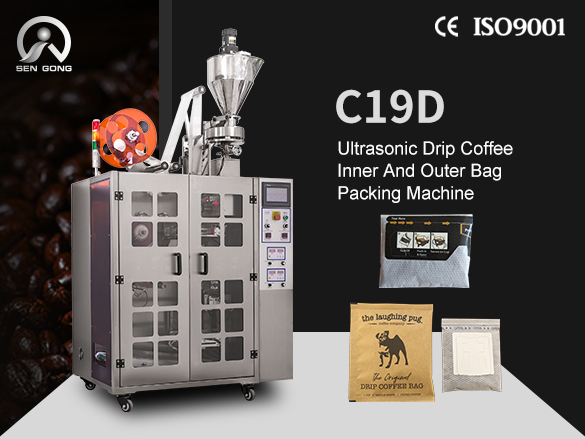
The C19H Ultrasonic Drip Coffee Inner and Outer Bag Packing Machine is one model available for further project evaluation.
Suitability should be tested with the intended coffee, filter, and outer film. Bag formats, speed, dosing, and optional functions should be documented in the agreed technical specification.
Provide:
Actual roasted and ground coffee.
Origin and blend information.
Roast and grind timing.
Target dose.
Inner and outer packaging materials.
Candidate envelope dimensions.
Planned operating speed.
Nitrogen requirements.
Existing storage observations.
Downstream carton format.
A traditional acceptance test may finish on the day of the machine trial. Degassing-related changes may become visible later.
Acceptance can therefore have two stages.
Check speed, dose, inner seals, hanging supports, outer heat seals, and coding.
Store samples under agreed conditions and later inspect shape, seal integrity, carton compatibility, and brewing performance.
The observation period should follow the product’s test plan rather than one universal number of days.
Indonesia offers a wide range of regional coffees, but the route from roasted beans to finished drip bags also requires control of degassing, envelope space, and seals.
An ultrasonic drip coffee bag packing machine can integrate dosing, inner-filter joining, and individual outer wrapping. A dependable project also needs a defined roast–grind–pack timeline and retained-sample evaluation.
Packaging completion is not the end of degassing assessment. The machine result is confirmed only when the pack remains functional through storage, cartoning, and transportation.
Roasted coffee may continue releasing gas. Retained air or gas flushing can also affect pack shape. Records and seal tests are required to identify the cause.
No. Ultrasonic technology primarily joins compatible inner-filter materials. It does not stop the coffee from releasing gas.
More space may change the appearance, but it does not eliminate degassing or repair a poor seal. The format requires storage and cartoning trials.
It should not be assumed. Coffee type, roast, grind, and packaging conditions may change degassing behavior.
Counseling Hotline
+8613779964655
E-Mail:sales@quickerpack.com
Mobile:+8613779964655
TEL:+8613779964655
Addess:228, Tianfeng Road, North Industrial Zone, Jimei District, Xiamen, Fujian, China.
CopyRight 2004-2026 Xiamen Sengong Packing Equipment Co.,Ltd All Rights Reserved XML MAP