CONTACT US
|
Wechat
WeChat:+8605925523433Wechat QR code,Contact us
WeChat:+8605925523433Wechat QR code,Contact us


“Saudi coffee” can identify two different products. One may use coffee beans grown in Saudi Arabia, while another may be roasted, packed, or formulated in Saudi Arabia using coffee from elsewhere.
Both can become drip-bag products, but their origin claims should not be confused.
Khawlani coffee is associated with cultivation knowledge and agricultural practices in southern Saudi Arabia. UNESCO inscribed the “knowledge and practices related to cultivating Khawlani coffee beans” on the Representative List of the Intangible Cultural Heritage of Humanity in 2022. Its description includes seedling preparation, terrace cultivation, harvesting, and drying.
When coffee with a defined origin enters an automated packaging line, the machine must do more than fill and seal. The production system should preserve the identity of the batch: which coffee entered which printed film, which settings were used, when it was packed, and where the finished cases went.
When “Khawlani” or a specific Saudi region appears on the package, the company should retain appropriate supplier, farm, organization, or purchasing records and align the label with the actual material.
When beans are grown in another country but roasted, formulated, or packed in Saudi Arabia, origin and processing locations should be stated separately. Local artwork or a Saudi-style recipe does not make imported beans Saudi-grown coffee.
A product containing both Saudi-grown and other coffees should be identified accurately as a blend. Exact label requirements should be confirmed for the target market.
The packing machine cannot verify the truth of an origin claim. Purchasing, quality assurance, and production records must provide that control.
Before packaging, coffee may remain in larger bags or production containers. The packaging line divides it into many individual retail units.
Packaging therefore connects the raw-material lot to the finished consumer product.
A practical record can associate:
Green or roasted coffee lot.
Roast batch.
Grinding time or batch.
Inner-filter material lot.
Printed outer-film lot.
Machine identification.
Production settings.
Packaging date and time.
Finished-product code.
Case and pallet identification.
If a weight, seal, flavor, or labeling concern arises, these records narrow the investigation.
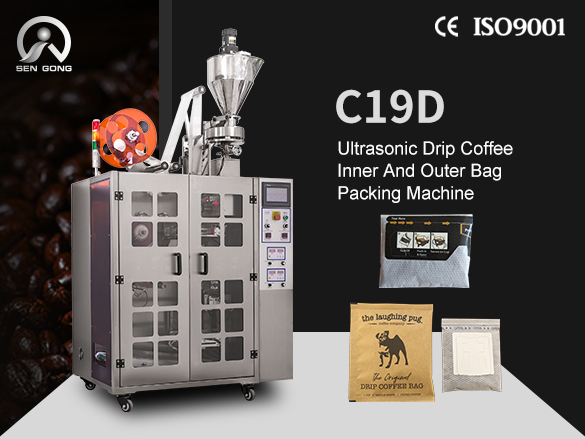
Depending on its model and configuration, the equipment may integrate dosing, inner-filter forming, ultrasonic joining, hanging-support handling, individual wrapping, and date or batch coding.
The machine dispenses ground coffee into the filter. Changes in grind, bulk density, and flow can alter the result. Several bags should be weighed after a product change, and the results linked to the coffee lot.
High-frequency mechanical vibration joins compatible filter material. It forms the filter structure; it does not verify origin or increase the grade of the coffee.
The process is not completely free of localized heat, and not every paper or nonwoven filter is compatible. Every proposed filter requires testing.
The supports should unfold conveniently and remain secure on the cup. Inspection should include opening, cup fit, and wet-filter integrity.
The envelope protects the ground coffee and carries product identity, origin, brewing instructions, and the batch code. It generally uses a heat-sealing process compatible with the selected film.
When the selected configuration includes coding, date, lot, or traceability information can be printed in a defined area. Format, position, and clarity require approval before commercial production.
A consumer-facing code does not need to display the entire internal record. It must provide a reliable link to that record.
It may include:
Production date.
Finished-product batch.
Line or machine identification.
Shift or time code.
Other information required by the company’s quality system.
The code should not be hidden by the seal, cutting position, or package artwork.
When a QR code is used, it should point to a stable, maintained page and undergo print-and-scan testing. A QR code does not replace information that must appear directly on the package.
A product carrying a defined origin requires strong protection against putting the correct coffee in the wrong film—or the wrong coffee in the correct film.
A changeover procedure can include:
Stopping the previous material feed.
Emptying the hopper and filling path.
Removing unused film and labels from the previous product.
Verifying the new coffee lot against the production order.
Checking the product name and version of the new film.
Loading the relevant machine settings.
Producing and inspecting a first-off sample.
Confirming weight, seals, artwork, and code.
Releasing continuous production after approval.
The remaining quantity of the previous packaging material should also be reconciled and recorded.
A mechanical failure often causes a stop, alarm, or visibly defective package. Incorrect printed film may still run smoothly and reach case packing.
Several products can use identical bag dimensions while carrying different origin, ingredient, or brewing information.
Before film is loaded, verify:
Product name.
Language version.
Origin statement.
Artwork revision.
Printing direction.
Registration-mark position.
Coding area.
Barcode or QR code.
Bag length and cutting position.
First-off approval should verify both machine operation and the content of the package.
Single-origin Khawlani coffee, Saudi-style blends, and standard filter products may use different doses, grinds, or films.
When a machine supports stored product settings, approved recipes can be established for each SKU. Loading a recipe does not remove the need to check actual weight and seals.
Recorded parameters may include:
Target dose.
Dosing settings.
Bag length.
Print registration.
Inner-seal settings.
Outer heat-seal settings.
Cutting and coding positions.
Approved operating speed.
Unauthorized parameter changes should be controlled or recorded where the selected control system allows it. Actual access-control functions must be confirmed for the model.
A record stating only “production completed” is insufficient. Each batch should retain quality results appropriate to the risk.
Sample at the beginning, middle, and end of the run and record weights and adjustments.
Inspect grounds in seams, joint continuity, and dry and wet filter integrity.
Check wrinkles, incomplete seals, contamination, and opening performance. Use the company’s appropriate seal test where required.
Record target water, drainage, support stability, and sensory results.
Record the filter and outer-film lots so material concerns can be traced.
A large collection of forms does not automatically create effective traceability. Conduct a simulation.
Select one finished bag and use its code to find:
The corresponding coffee lot.
Roasting and grinding records.
Packaging materials.
Packaging time and machine.
Dosing and sealing checks.
Relevant cases and shipment range.
A reverse test can begin with one coffee lot and identify every finished product, case, and order that received it.
If the information cannot be connected within the company’s expected response time, the coding or record process should be improved.
Xiamen Sengong Packing Equipment Co., Ltd supplies drip coffee, tea bag, and other beverage packaging equipment. Buyers can also review related solutions through the company’s VIPacker website.
The C19H Ultrasonic Drip Coffee Inner and Outer Bag Packing Machine is one model available for further project evaluation.
Compatible filters, envelope formats, operating speed, coding, and optional functions should be tested with actual coffee and packaging materials and documented in the agreed technical specification.
Provide:
Actual Khawlani or other coffee samples.
Target dose.
Number of planned SKUs.
Inner and outer bag dimensions.
Film artwork for each product.
Batch-coding rules.
Planned speed.
Changeover frequency.
Easy-tear, nitrogen, or downstream cartoning requirements.
In addition to normal speed, dosing, and sealing tests, acceptance can simulate a product change.
Using two films with similar dimensions but different artwork, verify whether operators can:
Remove the previous film.
Select the correct product settings.
Install the correct new film.
Enter the correct batch code.
Identify the wrong artwork version.
Hold changeover packs for inspection.
Complete first-off approval.
This evaluates the equipment, people, and procedures as one error-prevention system.
The value of Khawlani coffee comes from real growing communities, locations, and inherited cultivation knowledge. Modern packaging should preserve that identity through accurate labeling and verifiable records.
An ultrasonic drip coffee bag packing machine can perform dosing, filter sealing, and individual outer wrapping. Batch coding, film verification, line clearance, and quality records help every finished bag retain the correct identity.
A strong packaging line should answer not only how many bags were produced, but also which coffee they contained and where they were delivered.
No. Khawlani identifies a specific coffee and cultivation tradition. The actual raw-material origin should be verified before using the name.
No. Origin authenticity depends on purchasing documents, lot control, production verification, and traceability records.
No. The date or lot is an entry point. It should connect to coffee, packaging materials, machine settings, quality checks, and shipment information.
Different SKUs may share one bag size while carrying different origin, ingredient, or brewing information. Correct dimensions do not guarantee correct printed content.
Counseling Hotline
+8613779964655
E-Mail:sales@quickerpack.com
Mobile:+8613779964655
TEL:+8613779964655
Addess:228, Tianfeng Road, North Industrial Zone, Jimei District, Xiamen, Fujian, China.
CopyRight 2004-2026 Xiamen Sengong Packing Equipment Co.,Ltd All Rights Reserved XML MAP